
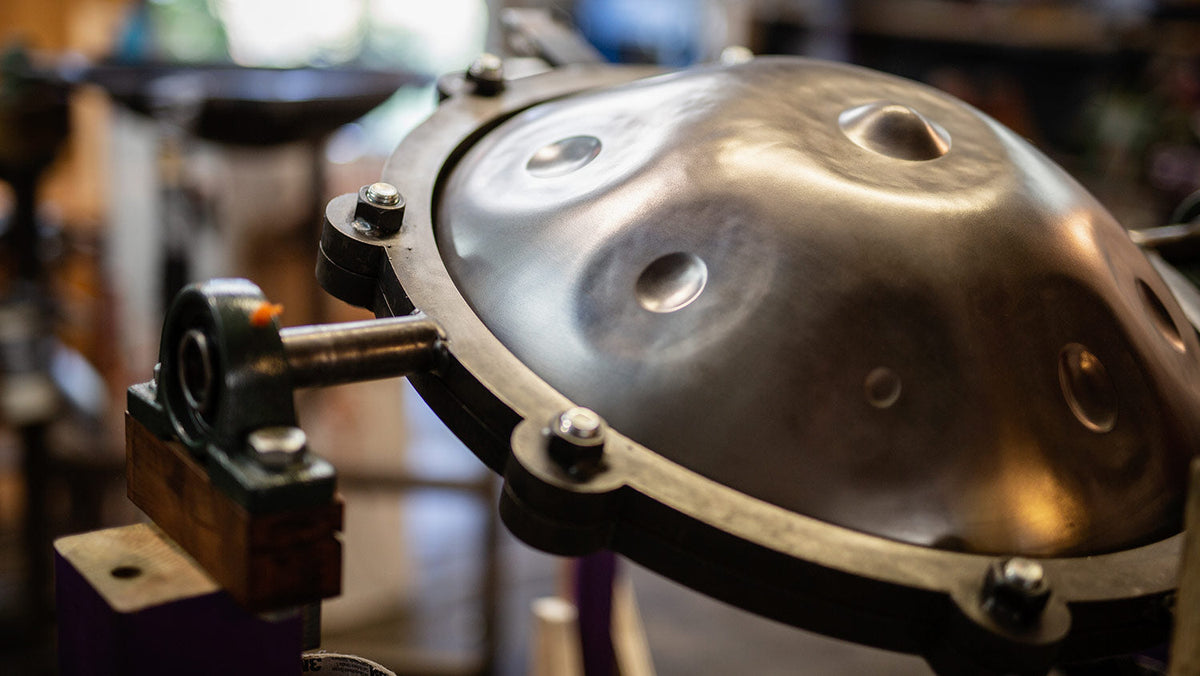
Handpan tuning: how does it work?
Discover how a handpan is tuned: expert techniques, high quality tools and all you need to understand how your instrument has been built or can be restored!

Table of contents
The architectural complexity of a handpan makes it one of the most challenging tuning instruments in the modern musical world. Unlike standard percussion instruments that produce a single, unpitched striking sound, every individual note field on a premium handpan is an intricate acoustic system designed to sing three distinct frequencies simultaneously.
For a single note to deliver that iconic, crystal-clear resonance, its three internal harmonic partials - the fundamental tone, the octave, and the compound fifth - must align in perfect mathematical harmony within a razor-thin tolerance threshold of ±2 cents. If even a single one of these structural partials experiences pitch drift, the entire tone field loses its geometric equilibrium, transforming a pure musical ring into a muddy, discordant vibration.
This guide covers the full tuning process: how to spot early frequency drift, why does it happen, which hammer techniques are used, and what tools a specialist brings to the job.
Why handpans go out of tune
To understand the core mechanics of pitch drift, one must analyze the handpan through the lens of structural engineering and metallurgy. The shell of a handpan is formed from raw steel that undergoes advanced thermal processing (such as nitriding or stainless-steel hardening) to lock the metal into a high-tension state. Each tone field is essentially an isolated, pre-stressed dome pressed into the shell. The vibrational frequency of that dome is completely dictated by two main physical variables: the internal tension stored within the steel's crystalline matrix and the precise micro-curvature of the metal.
When the three-partial model is perfectly balanced, striking the note field causes the fundamental, the octave, and the compound fifth to oscillate in an exact 1:2:3 frequency ratio. However, steel possesses elastic properties, meaning its internal boundaries can shift under environmental or physical strain. When this internal tension collapses or the localized curvature deforms by even a fraction of a millimeter, the vibrational frequency shifts away from its target pitch. Because a handpan is built on a fixed-scale architecture, a deviation of more than ±2 cents disrupts this delicate overtone alignment, throwing the note noticeably out of tune.
The physics of tone field drift
The internal architecture of a tone filed relies on a complex balance of compressive and tensile forces. The center of the dome, called apex, is responsible for the fundamental pitch, while the longitudinal and transverse axes running along the oval borders dictate the octave and compound fith overtones. Over time, the localized tension gradients within these axes can equalize or degrade.
When the steel's internal tension slackens, the curvature flattens out, causing the vibrational frequency to drop in pitch. Conversely, if localized stress points contract, the pitch can spike upward. This mechanical shift means that pitch drift is not a superficial detuning of a single string, but a structural deformation of the physical metal itself.
Common causes: temperature and heavy playing
Several distinct environmental and physical triggers accelerate this structural deformation:
- Thermal expansion: steel reacts aggressively to extreme heat. When exposed to direct sunlight or left in a hot car, the thermal energy causes the steel's molecules to expand. This temporarily lowers the internal tension of the dome, causing the instrument's overall pitch to drop. While the handpan usually returns to its baseline when it cools down, prolonged or repeated exposure to high temperatures can permanently warp the metal's curvature, keeping it permanently out of tune.
- Excessive strike force: the handpan is specifically designed to be played with a light, percussive touch using the soft pads of your fingers. Heavy-handed playing, using hard mallets, or accidental impacts subject the metal to intense localized shockwaves. This repeated force compresses the dome beyond its elastic limit, causing the steel to structurally shift and accelerating the need for a professional handpan retuning.
Do you want your handpan not only to stay in perfect tune, but also to keep its shiny, like-new look over time? Check out our complete handpan cleaning and care guide, and make sure to protect your instrument from impacts and temperature swings with a high-quality handpan bag.
How to tell if your handpan needs tuning
Before investing in a professional tuning service, players can easily self-assess the health of their instrument using two objective diagnostic methods. Recognizing exactly what an out-of-tune note looks and sounds like prevents minor frequency shifts from worsening over time.
Listening for pitch deviation and beating frequencies
The most immediate way to identify pitch drift requires nothing but an attentive ear. When a tone field begins to drift out of alignment, it often produces an unmistakable acoustic phenomenon known as beating. Acoustic beating is heard as a rhythmic pulsing, an erratic "wobble," or a rapid "wah-wah" wave effect during the note's sustain.
This happens because the fundamental pitch and its overtones are no longer perfectly locked into their exact mathematical harmonic ratios. Instead, the mismatched frequencies interact destructively, creating alternating waves of cancellation and amplification. If you strike a note and it lacks a clean, linear decay (producing an erratic, pulsing oscillation instead) the partials are actively fighting one another, confirming the instrument is out of tune.
Using a chromatic tuner to check each note
For a scientific diagnostic, players should use a high-resolution visual chromatic tuner or a dedicated strobe tuner application (such as Linotune, also available on App Store and Google Play) rather than a basic guitar tuner. To map out the instrument's health accurately, you must isolate and measure all three harmonic partials on every individual note field:
- The fundamental: strike the exact center of the tone field gently with your finger and note the primary frequency registered by your tuner
- The octave: place one finger lightly across the longitudinal axis (the long center line of the oval field) to dampen the fundamental pitch, then strike the side of the field
- The compound fifth: place your finger lightly across the transverse axis (the short cross line) to isolate the area, then strike the top or bottom edge of the dome
Record the exact cents deviation for all three partials across the entire layout. If any reading registers a persistent deviation beyond the acceptable ±2 cents threshold, your instrument officially requires professional handpan retuning to restore its structural coherence.
Technical mapping of handpan note partials
| Partial Type | Structural Location | Ideal Harmonic Ratio | Isolation Strike Method | Out-of-Tune Indicator |
| Fundamental | Center Apex of tone field | 1:1 (Baseline Pitch) | Soft, centered strike with the pad of the thumb or index finger | Tuner registers greater than ±2 cents deviation from the standard scale key |
| Octave | Along the longitudinal (long) axis | 2:1 (One Octave Above) | Dampen the center line; strike the outer lateral edges of the oval dome | Audible acoustic beating; pulsing wobble during the note’s sustain |
| Compound Fifth | Along the transverse (short) axis | 3:1 (Octave + Perfect 5th) | Dampen the cross line; strike the top or bottom apex borders | Deadened sustain; a metallic, hollow thud with zero overtone ring |
The tools of the expert
The process of how to tune a handpan is entirely subtractive and additive in terms of metal tension. There are no pegs to turn, strings to adjust or screws to tighten. Every adjustment requires carefully reshaping the steel shell under high structural tension. This requires a specialized and delicate toolkit. Attempting to modify the instrument without these specialized implements is highly dangerous, as using the incorrect hammer is the single most common cause of permanent, irreversible damage to a tone field.
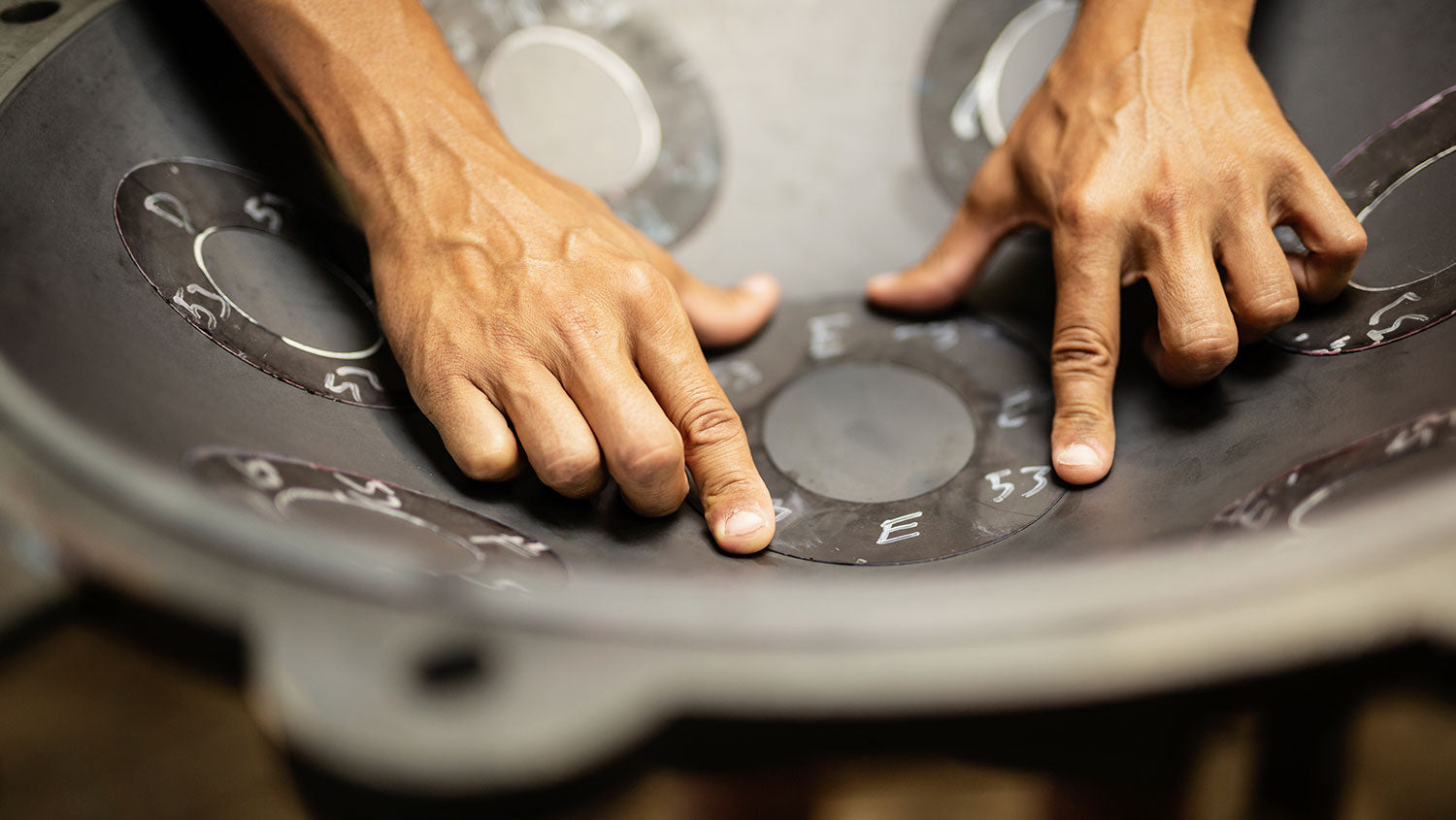
The hammer: the most important instrument
Master artisans utilize an array of highly specialized, precision-weighted hammers to re-balance the internal tension of the steel. These primarily include rounded-face, nylon-tipped and weighted ball-peen variants. The exact diameter of the striking surface and the structural hardness of the hammer face directly dictate how kinetic energy is distributed into the shell:
- Hard-faced and ball-peen variant hammers: these feature compact, hardened surfaces designed to deliver concentrated energy to highly localized micro-areas. Tuners use them along the strict boundaries and interstitial channels of the tone fields to isolate and tune the octave and compound fifth overtones without disturbing the rest of the layout;
- Soft-faced nylon and rubber hammers: these feature wide, forgiving surfaces designed to disperse kinetic force across a broader surface area. This allows the tuner to carefully adjust the overall curvature of the main dome, shifting the fundamental pitch without marring the steel or creating localized pressure points;
Please note: amateur attempts to use standard household metal hammers transfer kinetic energy too brutally. This immediately causes dented tone fields, over-stretches the alloy beyond its physical recovery point, and inflicts irreversible harmonic damage.
Risks of DIY tuning and when to call a professional
While online DIY tutorials often present handpan tuning as a simple weekend hobby, it is actually one of the most difficult, elite acoustic crafts in the modern music industry. Re-balancing three independent, co-dependent frequencies on a single piece of tensioned steel requires years of specialized apprenticeship and a deep grasp of metallurgy.
Damage patterns caused by incorrect technique
When an untrained individual attempts to tune a handpan at home, they almost always trigger one of three fatal failure modes:
- stress cracking: striking the steel with incorrect force vectors or at wrong geometric coordinates over-stresses the alloy’s crystalline structure. This can cause microscopic stress fractures to tear open along the borders of the tone field, permanently destroying the shell's ability to hold any acoustic resonance.
- deadened sustain (over-hammering): if an amateur keeps striking a note field in an attempt to find the right pitch, they can easily exhaust the steel's natural elasticity. The metal becomes completely work-hardened and deadened, leaving the note sounding like a dull metallic thud with zero sustain.
- permanent partial decoherence: because the fundamental, octave, and compound fifth all exist on the same physical dome, adjusting one partial inherently shifts the other two. Amateurs often find themselves trapped in an uncoordinated loop—fixing the fundamental while completely throwing off the overtones. Eventually, the metal becomes so structurally scrambled that it can no longer be corrected by a professional, ruining the instrument entirely.
What a professional handpan tuning service includes
When you trust your instrument to a specialized diagnostic workshop like Sound-Sculpture to retune handpan, it undergoes a meticulous, multi-tiered restoration process:
- Frequency analysis: the instrument is analyzed using diagnostic strobe software to map out the exact structural deviation of every fundamental tone and overtone partial across the shell;
- Harmonic realignment: using highly controlled, micro-calculated hammer strikes applied from both the interior and exterior of the shell, the artisan carefully coaxes the steel tension back into perfect equilibrium;
- Post-tuning quality check: the handpan is tested under various room temperatures and heavy playing dynamics to ensure the metal has settled firmly and will maintain its tuning stability over the long term;
Trust professionals and get your instrument retuned the right way! Contact us!
Maintenance schedule recommended by specialists
It’s always a good idea to go through a complete check-up of your instrument, even if real problems come when you notice the sound has changed. However, especially if your instrument ever experiences a direct physical impact, is accidentally dropped or undergoes prolonged outdoor exposure, you should contact your professional tuning instrument specialist immediately for an assessment.
Do you need to check and retune your handpan? We can do it for you!

About the author

Founder and managing director of Sound-Sculpture, handpan expert
Related articles

Handpan musicians: 10 artists redefining the instrument
Discover 10 handpan musicians pushing the boundaries of this remarkable instrument, from viral pioneers to UK street performers shaping the modern scene!
Letter notation vs Solfege: a guide for the modern music
Confused by Do-Re-Mi vs A-B-C? Discover the differences between solfege and letters, their history, and why handpan players prefer one over the other.

Major scale vs minor scale: the complete beginner's guide
A guide for beginners on major scale vs minor scale: learn how their patterns work and which one suits your handpan playing style.
How to clean a handpan: the complete step-by-step guide
Learn how to clean handpan safely with simple steps, the right oil, rust prevention tips and expert care advice to protect its sound and finish.