
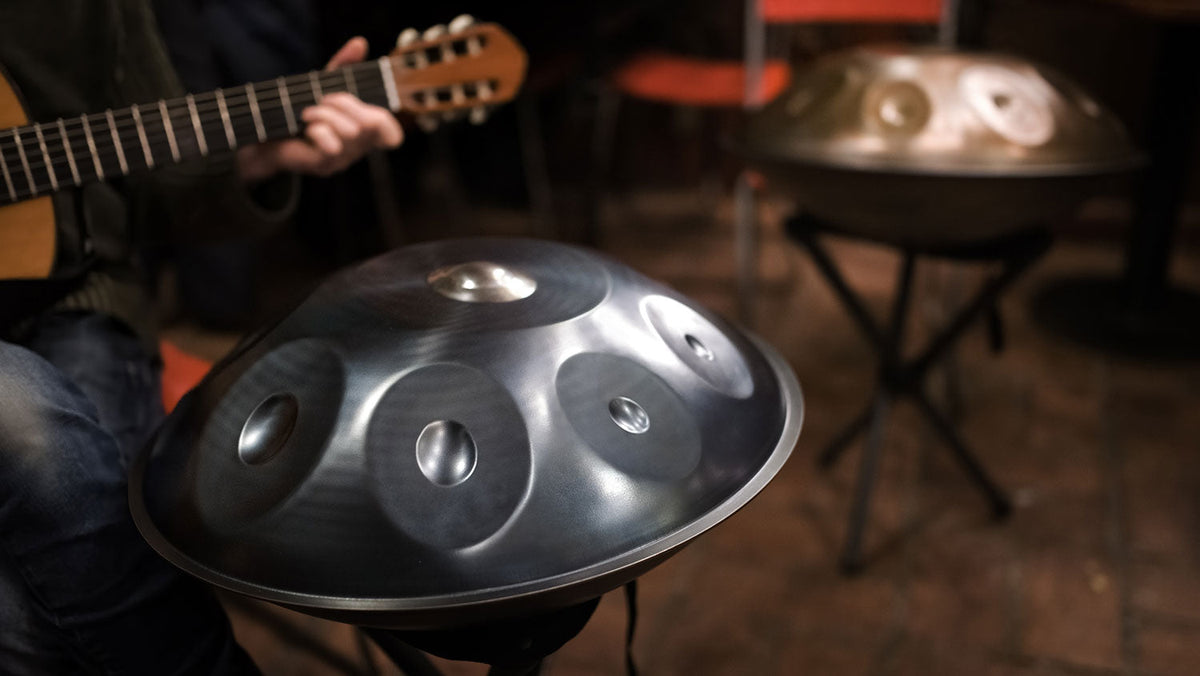
Letter notation vs Solfege: a guide for the modern music
Confused by Do-Re-Mi vs A-B-C? Discover the differences between solfege and letters, their history, and why handpan players prefer one over the other.

Table of contents
It is often said that music is the only truly universal language. Whether you are in a crowded street in London, a jazz club in New York, or a meditation retreat in the Swiss Alps, a minor third interval feels the same. However, while the sound is universal, the labels we use to describe those sounds are anything but.
For many aspiring musicians, especially those drawn to the enchanting world of the handpan, the first hurdle isn't the rhythm or the touch: it’s the terminology. You might find yourself watching a tutorial from an Italian or French master who speaks of "Do, Re, Mi", while your digital tuner and your instrument’s spec sheet are shouting "C, D, E" at you.
This "language barrier" is the result of centuries of diverging musical traditions. On one side, we have the Scientific Alphabetical system (Letter Notation), and on the other, the Melodic Solfège system. Understanding both isn't just a matter of trivia: it is the key to mastering your instrument and communicating with the global community of makers and players.

The Global Standard: what is Letter Notation?
If you have ever used a digital tuner, looked at a piece of sheet music in the UK, or opened a software like Ableton or Logic, you have encountered Letter Notation. This system is practical, linear, and undeniably "scientific". It uses the first seven letters of the alphabet (A, B, C, D, E, F and G) to represent the natural notes of a scale.
The foundation of scientific pitch notation
In the professional world, we often refer to this as Scientific Pitch Notation. By adding a number to the letter (like A4 or C5), we can identify the exact octave of a note. For instance, A4 is the global standard for tuning, vibrating at exactly 440 Hz. This level of precision is why Letter Notation is the absolute backbone of digital tuners and modern manufacturing. When a handpan maker in the UK or the USA is sinking a shell, they aren't aiming for a vibe; they are aiming for a precise frequency that corresponds to a letter.
Advantages of Letter Notation for the Modern Player
Why has this system become the dominant standard in the West? It comes down to its fixed nature. A "C" is always a "C", regardless of what key you are playing in.
- universal Communication: if you are ordering a bespoke instrument from a maker in Singapore or Germany, using letters ensures there is zero ambiguity. You aren't asking for "that sad-sounding note", you are asking for a Bb3.
- visual Mapping: for handpan players, the instrument is a physical map. It is far easier to label tone fields with a single letter (C, D, E) than with multi-syllable names. This allows for quick visual recognition during fast, percussive play.
- technical Accuracy: because Letter Notation correlates directly to frequency, it allows players to understand the physics of their instrument. Knowing that your Ding is a D3 allows you to understand how it will resonate with other instruments in a studio setting.

The romance of sound: understanding Solfège (Do-Re-Mi)
While the Anglo-Saxon world was busy perfecting the alphabetical system, the Latin world—specifically Italy, France, and Spain—remained deeply rooted in the Syllabic system known as Solfège. If you’ve ever seen The Sound of Music, you already know the basics: Do, Re, Mi, Fa, Sol, La, Si.
This system feels more “romantic" because it was designed for the human voice. It originated with an 11th-century monk named Guido d'Arezzo, who used the syllables of a specific hymn to help singers remember pitches.
The fixed vs movable Do debate
This is a high-volume topic in music theory, and understanding the difference is vital for UK-based players.
- fixed Do: in countries like Italy or France, "Do" is synonymous with "C." It never changes. Do always equals C.
- movable Do: in the UK and much of the English-speaking world, Solfège is often taught as a relative system. In movable Do, the syllable "Do" always represents the root note (the tonic) of whatever scale you are playing. If you are playing in G Major, G is "Do."
For a handpan player, movable Do is an incredible tool for ear training. It helps you understand the function of a note. You stop thinking "I am hitting a G" and start thinking "I am hitting the Root" which helps you internalize the emotional "flavor" of the scale.
Why the handpan world chose letters (A-B-C)
In the global handpan community, standardization is a matter of survival. Because the instrument is so young and its makers are scattered across every continent, we needed a language that didn't get lost in translation. This is why a D Kurd scale is never referred to as a "Re Kurd" scale, even by French or Italian makers.
Clarity in specific frequencies
The handpan is an instrument of specific frequencies (Hz) and precise tuning. Each note consists of a fundamental, an octave, and a compound fifth. To communicate these complex acoustics, the Alphabetical system provides a clarity that syllables cannot. When you visit us at Sound-Sculpture, our shelves are organized by these letters. You need to know your D from your C# to ensure you are selecting a scale that matches your existing collection or your favorite backing tracks.
Buying vs feeling
There is a functional split in how we use these systems:
- buying and tuning: you use letters. You heck your tuner for “D3” and you order a C Minor handpan.
- feeling and instruction: you might use solfège. When you are learning a new melody, your instructor might tell you to "sing the scale: Do, Re, Mi..." because it is easier to vocalize syllables than letters. Solfège brings the "soul" to the practice, while Letter Notation provides the "structure". In any case, this is not very likely to happen unless your instructor comes from Italy, France or Spain.
The “B” or “H” mystery: a quick note for european travelers
If you are a UK player looking at a handpan made in Germany, Austria, or parts of Scandinavia, you might run into a confusing "glitch" in the matrix. You might see a scale listed with an "H."
In the German musical tradition, the letter "B" actually refers to what we call Bb (B-flat). To represent what we call B-natural, they use the letter "H". This dates back to a centuries-old printing error where the symbol for a "square" B (B-natural) was mistaken for an "H". It has stuck ever since. If you are buying a German-made instrument and you see an "H3"... don't panic, it’s just a B3! Knowing this simple quirk can save you from an expensive ordering mistake!
Comparison table: notes at a glance
To help you navigate between the two different notations, here is a quick reference table:
| Letter (UK / Global / Scientific) | Solfège (Latin / Fixed Do) | Handpan Context |
| C | Do | Common root for major scales |
| C# / Db | Do# / Reb | Vital for C# Annaziska and deep minor scales |
| D | Re | The most popular "Ding" note (e.g., D Minor) |
| Eb / D# | Mib / Re# | Common in Integral or darker minor tunings |
| E | Mi | Found in many meditative E Amara scales |
| E# / Fb | Mi# / Fab | Rare in handpan, used in complex “exotic” scales |
| F | Fa | A frequent "shoulder" note in minor pans |
| F# / Gb | Fa# / Solb | Adds a bright, celestial feel to your play |
| G | Sol | Often the highest note in beginner 8-note pans |
| G# / Ab | Sol# / Lab | Essential for A Minor scales or C# Minor layouts |
| A | La | The standard frequency |
| Bb / A# | Sib / Lab | The signature note in a D Kurd scale |
| B (or H in Germany) | Si | Provides the leading tone in major scales |
A quick note on E# and Fb: in music theory, these are known as enharmonic equivalents. On a fixed-scale instrument like the handpan, a maker will almost always label a note as F rather than E#, or E rather than Fb, simply to keep things clear for the player. However, if you are studying advanced music theory to compose for your handpan, knowing where these fit in the sequence is a total pro move.
Which system should you learn?
If you are just starting your journey, you should absolutely focus on the Letter System first. The reality of the modern handpan market is that letters are the primary tool for navigation. Every high-end maker's catalog, every digital tuning app and every professional YouTube tutorial will refer to "D3", "C#", or "Bb". Mastering the A-B-C system early on will prevent confusion when you are buying your first instrument or trying to tune your notes. It is the language of professional production and global trade.
Solfège is something that can (and should) come after. Once you have a handle on where the notes are on your pan, using "Do-Re-Mi" for ear training and singing your melodies will add a layer of soulful expression to your playing. But for the foundation? Stick to the letters.
Of course, once you’ve mastered both, being "bilingual" is a serious advantage. It allows you to talk technical specs with a world-class maker while singing beautiful melodic intervals like a seasoned maestro.
Final thoughts: speaking the language of steel
The handpan is a bridge. It is a bridge between percussion and melody, between ancient sounds and futuristic materials, and between different musical cultures. When you sit down with your pan, you aren't just hitting steel; you are interacting with a system of labels that spans over a thousand years of human history.
Don't let the "B vs H" mystery or the "C vs Do" debate intimidate you. Whether you call it Re or D, the vibration remains the same, and the feeling it evokes is what truly matters.
Are you ready to start your journey with the language of steel? If you are just beginning to explore these scales and labels, visit our handpan for beginners page. We’ve curated the best resources to help you choose your first scale, understand your notes, and find the instrument that speaks your language.

About the author

Founder and managing director of Sound-Sculpture, handpan expert
Related articles
Handpan tuning: how does it work?
Discover how a handpan is tuned: expert techniques, high quality tools and all you need to understand how your instrument has been built or can be restored!

Handpan musicians: 10 artists redefining the instrument
Discover 10 handpan musicians pushing the boundaries of this remarkable instrument, from viral pioneers to UK street performers shaping the modern scene!

Major scale vs minor scale: the complete beginner's guide
A guide for beginners on major scale vs minor scale: learn how their patterns work and which one suits your handpan playing style.
How to clean a handpan: the complete step-by-step guide
Learn how to clean handpan safely with simple steps, the right oil, rust prevention tips and expert care advice to protect its sound and finish.